Back in 2018, I had an
opportunity to attend a concert in New York City given by the master
of the Hindustandi Slide Guitar – Debashish Battachyra. I had
picked up a CD of his that dated to the early 1990s because it looked
so amazing:
I found the music placed
me in a contemplative frame of mind and gave me a sense of well-being
at a time in my life that was more tumultuous than I may have
realized consciously. Having discovered his social media page, I
began following his current activities and was surprised to see an
announcement of a show in Manhattan that looked like I could get to.
I'm pretty sure I was able to order a ticket online and drove the 60
some odd miles south on a weeknight in Oct to catch the show. It was
held in an auditorium in a college on the upper west side of
Manhattan and battling traffic proved challenging – including
finding parking.
I got there so early I found myself waiting and
wondering if the concert was going to happen at all – nobody was
there or seemed to know about it. Gradually, attendees and performers
arrived, yet the modest auditorium did not fill to the capacity it
should have. With all the stress of getting there after a long day at
work I had developed a headache and general sense of discomfort that
goes with such stress. I also hadn't had much to eat which didn't
help matters. Yet, as the music began I had the most amazing
experience – my pain and discomfort from the day's stresses was
LIFTED and by the time the performance concluded I was pain free and
feeling FANTASTIC! The musicians included Debashish, his brother
Subashish on tabla and daughter Anandi on vocals. Having been gifted
a literally HEALING performance, I made sure to purchase two discs
that night after the show:
Subashish's album is more
modern in the sense of being reflective of the kinds of production
qualities found in modern music today. Highly orchestrated, dramatic
and in some ways cinematic in its presentation. The focus feels more
on composition than instrumental virtuosity. The scope and depth of
the music continues to be a source of fascination with each listen.
Anandi's album features a
more streamlined approach with some refreshingly stripped down
arrangements where the voice and instruments are featured and really
shine! Her compositional approach is engaging and memorable. I can
easily recall the pieces in my mind's ear in between spins of the
disc itself. Both approaches are different enough from each other –
and from the Hindustani Slide music – to provide enjoyable
contrasting sonic experiences.
Since then I'd been on the
lookout for a new release from Debashish himself. My patience was
rewarded with a new recording titled The Sound of the Soul. From his
Bandcamp page I chose the signed CD option (with the download
available in FLAC format as well). The disc arrived within the week
and features a warm and glowing word of recommendation from the great
John McLaughlin on the inside panel of the disc cover. I can only
echo the sentiment from such an esteemed admirer – the disc is
essential listening for guitar music enthusiasts. I hope to hear this
brilliant musician perform in person again. For now, the recordings
sustain me and create a sense of well-being and hope for a troubled
world.
It seems like 2022 was a
year of unexpected musical miracles and a prime example was the
release of the first Jeff Cotton solo album. It was surprising enough
to see him surface on social media and in interviews the year before,
but a whole album of music was a total shock! Although the absence of
a drum kit drummer is notable in the sound, the overall music is so
full of adventure, joy, musical surprises and that slinky slide
guitar we all know and love – it's a feast for the ears regardless!
I hope he releases more music as he has promised to do since I've had
so much enjoyment from this first album. Maybe the Beefheart
die-hards are the main target audience, but Cotton's music has a
universal appeal that can't be denied. And he sure can sing too –
not just Ella Guru!
Bringing the focus back to
some classical musings – I was inspired to dig out the ONE version
of Bruckner's 3rd Symphony I found most tolerable if not
enjoyable. The CD pictured above was purchased in a fit of
desperation since other versions of his 3rd really turned
me off. For the life of me I can't recall why I took a chance on this
one. Either it was a random purchase or I found a recommendation
online. My money is on the former reason. Considering that the
recording – of the Netherlands Philharmonic Orchestra led by
Hartmut Haenschen in 1991 – is fairly strident and brash yet still
somehow suitable to the music, I can only imagine why other versions
turned me off. If I recall, one of the tricky problems associated
with Bruckner's music is how he would revise things so some
recordings feature older scores while others feature revised scores.
Or some such confusion. It had been awhile since I buckled in for the
Bruckner 3rd challenge and at least this version felt
right. Listening to more of my classical CDs is likely to be a going
thing since life's a bit tricky having classical LP spinning time in
the house. No matter – I may be tempted to pull out that Bruckner
cycle in that Jochum box I have sitting around to compare the 3rd
with. Still, I'm not parting with the Hartmut miracle disc. I'm so
looking forward to exploring more classical vibrations in times
ahead!
I'll wrap up part one here
with a proper vinyl issue released last year of, essentially, the
last official album put out by Robbie Basho in his lifetime –
Bouquet. I was very interested in this new edition since the only
other official release was on cassette back in the early 80s and the
transfers I'd heard from internet sources were quite underwhelming to
say he least. With the new vinyl reissue, the sound is superb. I'm
not sure what the source was, but the result is on par with the vast
majority of the items in Robbie Basho's catalog. The proceedings,
musically, are a fascinating composite of several “bags” Basho
had explored up to that point while pulling the most accessible
elements together in one place. There are a number of vocal tracks
mixed in with familiar themes from earlier albums. The liner notes
included – composed by Glen Jones – address the notion that
Robbie Basho was looking to find a wider audience for his art, even
beyond the frustratingly broken promises of being connected to the
Windham Hill roster. Yet, being a cassette only release was not the
hip-culture move in those days that it is today. And with limited
distribution it would have remained an obscure item were it not for
the steadily growing interest in Robbie Basho's music over the last
20 – 30 years. As Glen Jones points out, if there is any cause for
pause in this essential listening experience, it rises from a
slightly overenthusiastic desire on the part of the artist to court
the favor of his listeners, not unlike his fervent paeans to the
various muses heard so earnestly in earlier releases. Still, Basho's
raw visionary talent overtakes any awkwardly expressed devotion to an
invisible “beloved” - it's not impossible to be even somewhat
swept away in the river of sincerity that is very obviously the
source of the inspiration. Quite simply, the new LP is the BEST
version of Robbie Basho's last complete expression and is therefore
essential for far more than the diehard devotees.
This concludes part ONE of
a series …........ part TWO of which is already in the pipeline.
Listen on, up and beyond!
Not a subjective “truth”
- the real truth. And, to be clear, that which is beautiful is what
uplifts humanity. To put these ideas front, top and center is always
a matter of vigilant urgency and perhaps moreso under the current
climate of world unrest. It may be worth proposing that war, as a
means to subjugate a peaceful nation that poses no threat to a
neighbor, is an abomination to all those who value truth and beauty.
For those of us not on the front lines of the immediate conflict,
being vocal about supporting the defenders of democratic values –
not to mention truth and beauty – may seem insignificant. However,
watching silently as the bullies run roughshod over the weak is never
a noble option. Any sentient being with a conscience – and access
to the truth – can easily understand the dangers of autocracy and
totalitarianism. Although flawed in a variety of ways as an ongoing
experiment – United States style democracy is still a valid export.
Movements contrary to the ideals put forward in the Declaration of
Independence and the US Constitution are just as destructive and
pernicious now as they ever have been at any point in history.
Universal Human Rights are exactly as described and it is the job of
any modern government to uphold those rights or be vanquished.
Witnessing the
unfolding of the Russian invasion of Ukraine is among the saddest and
most frustrating world events I have ever had to live through. As I
write, the war is relatively “new” and alarmingly concerning –
especially to those like myself who lived through the Cold War and
all its attendant paranoias. Plenty of governments around the world
are headed up by madmen, true enough. Just how bereft of sanity Putin
may be is NOT something I want to think about for too long – or to
have it proved in the most destructive of ways. Yet, no need to
consider the severity of his affliction – the evidence is already
visible. So, in the grand scheme of heavy-duty shit to think about,
music and culture may appear to be diversions for the fortunate. Fair
enough. Yet, it is the duty of those who have the ability to take a
stand for truth and beauty through the humanities, which has ever
been my take on it and the purpose of making any small contribution
to that end. In the spirit of all that – I was quite moved by the
new Pink Floyd song - a collaboration with talented singer
Andriy
Khlyvnyuk from the Ukranian band Boom
Box. Listen here:
A stirring statement
indeed. I've been a longtime fan of Gilmour and company (maybe a bit
more than Roger Waters as a solo entity, certainly). Considering how
much of the Pink Floyd catalog is imbued with the topic of the
destructiveness of war – the new offering is entirely within the
aesthetic of the band's output. From a musical point of view, Floyd
fans are treated to wonderful extended Gilmour soloing and plenty of
Nick Mason's tom-tom work (one of the strengths of the song in my
opinion). What a different world we have today from the one of Pink
Floyd's humble beginnings.....
1967 is so far away. It is
difficult to imagine how a sense of idealism could be evident at a
difficult point in world history even then. Cold War, Vietnam War,
environmental ruination, social unrest and violent reactionaries
acted out on a confrontational stage – culminating perhaps in the
following year. Although times were bad then too, a sense of idealism
did counteract the doom and gloom – however naive it may have been
in retrospect. Did that shred of hope really evaporate in 1968?
Flower Power might not have transformed the world, but it did
represent hope in the face of doom.
For reasons I can't
recall, I threw my Uruguay copy of Sgt Pepper on the turntable
recently. I sang along with the songs to my little son as I puttered
around the house and was struck by the idealism of the music. It
reminded me of an excellent documentary from 1987 appropriately
titled “It Was Twenty Years Ago Today”.
In one place you get to
see Allen Ginsberg, Abbie Hoffman, Ed Sanders and leading figures of
the international emergent counterculture – particularly the
Diggers. I'll also recommend perusing the other parts of the Diggers
site. Fascinating stuff!
1987 is further in time
from us now than folks were from 1967 in that year. Yet, it seems
like the world changed more in those 20 years than it has from 1987
to our time. This may or may not be entirely true, but hedging on the
possibility that it IS true I'll put the blame on what Ed Sanders
roughly termed “The Creeping Meatball”. To get a working
definition of what that is, a little extra reading is necessary so
I'll hand you over to Ed circa 1968 for a few minutes. Curiously, he
has a few things to say about Beauty and Art versus BS as well. Take
it away Ed:
We all know how the rest
of 1968 played out and I'll tie in to 1987 to suggest that the
Creeping Meatball won, for the time being. However, I'll also make
the observation that the present era is undefined with no clear
outcome of how much the Creeping (or Galloping) Meatball may or may
not prevail, ultimately. If Ed was pissed off at the LBJ / Nixon axis
of crud in his time, we have a whole new cast of villains to contend
with now. But what, if anything, represents hope today? I'm not done
looking. Before we abandon 1987 though I'll pause to consider a few
noteworthy vibrations......
1987 might not go down in
music history as a particularly watershed year, but I can recommend a
few noteworthy moments. The first one didn't even hit me until many
years later – in the mid 2000s actually.
MEAT PUPPETS – MIRAGE
By the time I got around
to grabbing this CD used, 1987 had long passed. I found it cheap and
bought it because I'd always wanted to hear what the Meat Puppets
sounded like and figured I'd give them a go. It is worth explaining
that I totally missed their inclusion on Nirvana's Unplugged
appearance in 1994 since I wasn't a Nirvana fan. Plus, despite all
the advertising done by SST I never managed to hear the Meat Puppets
anywhere. This was ultimately a good thing for me since I had nothing
to go on, except the notion that they were a heavy rock SST type act.
MIRAGE threw me for such a loop when I heard it the first time I
totally dismissed both it and the Meat Puppets in one fell swoop.
MIRAGE sported the big sonic turn-off for me: electric, programmed
drum tracks. The band is just guitar, bass, drums and they can't even
be bothered to record REAL drums in that format? What the hell!?!
Of course, I later
discovered the idea of using drum tracks / triggers, etc....was an
aesthetic choice – what was considered “industry standard” at
the time (think: BON JOVI). I also eventually discovered a full
MIRAGE-era concert recording from 1987 where the band rips through
the whole album live (real drums of course) and it's a corker!
So..........gradually I found myself re-evaluating the whole notion
of live drums – or ANY drums for that matter and realizing – it's
all an illusion anyway. The kooky nature of the recording of MIRAGE
gives it the unique feel that it has and it works. The Meat Puppets
had nothing to prove on record as far as being a kick-ass live band.
Records are for radio. Live music is for the fans. So anyway, thanks
to Derek Bostrom for yanking me out of my snobby “real drums only”
mentality – and I'm being serious here!
For lots and lots of
great, free live Meat Puppets shows, check out this cool online
archive:
And as for MIRAGE, oddly
enough it is the album that got me to love the Meat Puppets. It's
probably a good thing that I never saw them live back in those days.
Hearing the fun Live in Montana 1988 release made me realize I could
have easily never gone to college and followed them around the
country Grateful Dead-style. And that would have been a horrible
waste of time, however fun!
Speaking of the Dead and
1987, it dawned on me that this was the big comeback year for those
guys with the In the Dark album and Touch of Grey in heavy rotation
on MTV. The one and only time I ever saw the Grateful Dead was in
July 1987 at Giants Stadium with Bob Dylan. I thought the Dylan
segments of the show were lackluster – but the Dead were on top
form! They might have been past their peak, but I'm glad I went. Come
to think of it, that show was the last stadium rock concert I ever
went to. By that point I was more excited to see up and coming acts
in small venues. Witnessing the Dead Milkmen playing a community
center in Poughkeepsie NY in 1986 was an eye-opening experience for
me! Way more fun than watching a classic rock band in a stadium.
Who I didn't get to see in
1987 or 1988 was Husker Du – the band I thought was poised to break
through and change music in the right direction. Funny though – I
didn't get their last studio album Warehouse: Songs and Stories at
the time. So it, like the Meat Puppets album, is not tied in to my
memories of that year, strangely enough. What 1987 showed me was a
direction out of my childhood. I had discovered an identity totally
away from the friends I had as a kid and with one year of high school
left, I was ready to move on to a whole new direction in my life. I
consider myself fortunate to have lived during a time of peace and
relative calm, even though I saw economic changes swirling rapidly
around me – the family business was in trouble due to the emergent
globalization taking place. Lets not forget it was Republican Nixon
who opened China to trade before we pin it all on Clinton and NAFTA.
I saw the whole thing changing during the Reagan years long before
Clinton. The shoe industry in the United States must have been among
the first to move overseas and my family felt the hit long before
many others. So much for Reaganomics! Bah!
Before I get too stuck on
1987 it is worth remembering there is LOTS of great new music
happening right now as well as new releases of older vibrations....
For example:
Time Outtakes – a
wonderful alternate-takes LP from the classic Dave Brubeck Quartet. I
have no idea if this material was ever issued on CD before, but this
is essential listening. I found this new-ish release fairly cheaply
online – beautifully restored from the original tapes by expert New
York engineer Scott Petito (also bass man for The Fugs!). Can't say
enough positive things about this release. Happy to hear more
recordings from the old Columbia church studio on 30th street in New York City (now demolished, alas). Cheers to Petito for
preserving the unique drum sound of that studio which captured Joe
Morello's artistry behind the kit in dramatic fashion. Now THERE'S
some great natural drum sounds for ya!!
Robbie Basho – Songs of
the Great Mystery
A new release of “lost”
album material from Robbie Basho. These recordings were available as
a download for awhile, but the music is presented to better effect on
this fine release from Real Gone Music. As troubled as he was, Basho
managed to create some beautiful, healing music that remains a
totally authentic expression of his vision and artistry. Excellent
liner notes from Glen Jones as well. Highly recommended.
Maki Asakawa
This is a compilation
double LP made up of choice tracks from the sweep of this fascinating
singer's career. Although the singing is all in Japanese, the
aesthetic of the music reflect the artist's interest in American Jazz
and progressive music. The years span mainly across the 1970s and the
music is imbued with the sensibilities of that decade. For those of
us who have heard all the great hit music of that decade from the
English singing artists, international acts can be a welcome sonic
diversion. The liner notes don't add much to the history of who Maki
Asakawa was – she was a fairly private person despite her public
singing career. In the end, its the music that matters and this 2 LP
set is an inexpensive introduction for the curious.
For new NEW music – the
following are recent acquisitions....
Ryley Walker – Course in
Fable
Of all the artists I
latched onto in the last several years, Walker has been among those
I've stuck with. This most recent release builds on the more
experimental jazz-rock songcraft developed on his 2018 offering
Deafman's Glance. Listening to his breakthrough album from years ago
Primrose Green it is easy to hear that Walker is more comfortable
with his current explorations – he has grown considerably as an
artist. It's been a rewarding journey as a listener so far and if his
bandcamp activity is any indication of where he's going there will be
lots more to look forward to. Hooray!
Gwenifer Raymond –
Strange Lights Over Garth Mountain
This was a tough record to
find for a reasonable price. Of all online sources, Target was the
cheapest – go figure. Raymond is a ferocious guitarist in the
advanced American Primitive tradition. The goth vibe is pretty thick
here as well, but it's the adventurous music that is the real selling
point. I'd bet she's great to see in a live setting!
Jake Xerxes Fussell –
Good and Green Again
I admit to being persuaded
by a bit of online advertising from Paradise of Bachelors here, but
I liked the clips I heard so why not? The music is a different take
on the Americana genre – the guitar work is stately and thoughtful
with a down-home, no-frills vocal approach on top. It's a calm,
slightly wistful record. I found the vinyl record sounded way better
than the download. Not sure what accounts for that or if it was my
imagination, but this is a record I can throw on anytime. Still
digging through it's many layers of enjoyment........
NRBQ – Dragnet
The most recent LP from
the legendary band. A short and sweet record with some excellent new
songs from Scott Ligon, Casey McDonough and company. Side two kinda
runs out of steam, but for $12 I know I got a great deal! And the
John Perrin song is way better than one might predict! It will be
great to see this talented version of the Q live again!
Lilly Hiatt – Lately
Yes – you know its a new
era when a new cassette-only release hits the mailbox. I couldn't
resist. The price was right and I was intrigued to hear what John
Hiatt's daughter might cook up. The only odd thing about this great
new release is some guitar effects found on the second track - the
warbling nature of the effect was kinda distracting in the cassette
format. Something just didn't sound right so I preferred to listen to
the download of this title. Still, I think it's fun to have purchased
a new pre-recorded cassette of a new release. Lilly Hiatt is a
fantastic artist by the way.....check out this compelling video
performance here:
From the long-awaited
category.............The Pineapples – Incommunicado
Wow! A great new offering
from the ONLY modern rock band that matters. The Pineapples keep
getting better with every new release and so far Incommunicado is the
group's high-water mark.
But wait – what about
Classical music? What happened to that? Still happening
friends........
Lately I've been on a
Debussy La Mer – a thon of sorts. Comparing many different versions
of this beautiful piece:
Yet, the big AHA moment of
recent listening happened when I took this MFSL copy of Carmina
Burana out for a spin.
It's a real shame that the
first few minutes of this piece have been used for every violent
video game commercial ever produced because the rest of the work is
so much better and fascinating than the opening (and closing) famous
minutes can suggest. Maybe it's now in the “warhorse” category
for most folks, but not for me. I will also swear on a stack
o'hundreds the second movement was a direct influence on the Moody
Blues Days of Future Passed. I was totally surprised to enjoy this
piece as much as I did. It will come out for more spins in the
future.
There's more music to consider and more positive vibrations to send out to the universe. With any luck - better days ahead through the dark times. In the words of the great Joel Dorn - "Keep a light in the window...."
Well, there actually is a real benefit from being a music obsessive - the freedom to transcend the BS of life when possible. It isn't always possible since life can be horrific as human history bears out. One doesn't have to look too far - geographically or otherwise - for examples where music is the LAST thing on anyone's mind. But in those moments when we get to choose what to think and how to think about the world around us, music can provide a useful lens - an alternate reality through which to construct meaning out of the seemingly random events of life's cacophony.
As I mentioned in the last post, the focus of this
blog is going to shift beyond the classical realm to be more inclusive of the
music I’m listening to and thinking about from all genres I like. Yet, the reason
I’m keeping this blog as the active one is because of the classical content. Though
I’ll never be a serious music scholar I do get a lot of enjoyment out of interacting
with the music and learning what I can as I go along. If I discover anything
useful or fun I’ll continue to pass along the vibrations as usual.
Every so often I do get a little sense of being on the
right track – or at least having my feelings about the music reinforced from those
more eloquent than I. One of my favorite music books is The Rest Is Noise by
Alex Ross – a truly eye-opening and ear-opening work. Ross is a writer of exceptional
talent, perception and vision. He is a contributing writer to several
periodicals including The New Yorker. Last year I had the pleasure of discovering
an article he’d written about appreciating Brahms in times of loss and life’s
difficulties. Here is a link to that article:
In a short essay, Ross manages to put into words the
way I’ve found myself reacting to Brahms since I began listening more
seriously years ago. I'd even read the complaints about Brahms and thought "Is there something wrong with me?" Ha! Not that I needed Ross to legitimize my enjoyment - I just really appreciate his usually brilliant insights and scholarship.
I immediately took to Brahms 3rd and 4th Symphonies years ago. These days I'm developing an appreciation for his 1st and 2nd Symphonies. I pulled out this Solti / CSO box to give the 1st a spin. I forgot how jarring and pessimistic the opening was - yikes! But it all gets resolved in the 3rd and 4th movements where really beautiful stuff emerges.
I had a similar reaction to this Piano Concerto No. 2 record:
A lot of pyrotechnics in the first two movements, but the 3rd movement is where this piece really came to life for me - really beautiful music! I'd have to do some reading up on Brahms as a composer to figure out if my impressions about his intentions are what I suspect. Won't pursue that idea any further now until I do. Need to dedicate some more time to listening and studying up on Brahms. Ahhh - dedication..........
For those really dedicated, there are multiple pathways as usual. Like it or not, Charles Ives sold insurance. That was his day job. Is his art any less valid? Robbie Basho was a stock clerk at times. The guys in The Minutemen organized their tours around their day jobs. Gotta hustle to survive, as always. Which coincidentally is the title of this great Les McCann album from 1975. Atlantic Records was about to shift focus away from the more straight ahead jazz to more commercial crossover stuff which suited Les McCann since he had hits like Compared to What.
This was his second to last LP for Atlantic. Jazz was going through changes and so too was the music business in general. As a company, Atlantic became part of the WEA group as a result of a merger and the focus went to rock groups like Led Zeppelin. Many of the jazz artists, if they didn't have soul crossover hits, were being phased out. Even if they DID have hits like Les McCann. 1976 would be the end of Atlantic's jazz roster as it had been. Other labels would try to absorb the cast off artists - McCann went to ABC while others went to Warners or A&M. The attempts of those companies to support jazz artists would be short lived as the late 70s yielded to disco and eventually the origins of rap and hip hop.
So all of this buzzes around my mind when I listen to Les McCann's last few Atlantic records. The very last album is really wonderful - River High River Low.
Both are reflective of the end of an era - in a business sense and on a cultural level. These changes happen so quickly - even in the business world. Companies rise and fall. What might appear to be fixed and stable is more often an illusion. I was a young boy when this music was new and though my memories of those days are preserved in flashes and moments I can relate to the feelings. The country felt different then - not so polarized, or so it seems. Hard to know since I was a kid in the 70s. But considering the events of Watergate - as damaging as that was (or should have been) - life went on. Perhaps what we were missing was a glorification of bad behavior in the culture. The closest thing may have been the reckless rock stars behavior, but it was widely understood most folks would never get away with Keith Moon type antics in the everyday world.
Digressions aside, there are still plenty of unexplored musical horizons out there to discover. I know it's probably old news by now, but the most recent Pharoah Sanders collaboration with electronic artist Floating Points and the London Symphony Orchestra is one of the best things I've heard in a long time!
Although I eventually wound up with this on vinyl I first heard it via youtube when it popped up as part of the algorithm of my searches there. I didn't know if it was new, old or what. The day I first heard the music (most of it) wound up being indelibly linked to a very significant event - the day my wife went to the hospital to deliver our son! Pharoah Sanders has been a favorite of mine for many years so it knocked me out to know he had this wonderful new music available. (I did not name my son Pharoah, however....) So, many thanks to these great musicians for providing a stunning soundtrack to a joyous moment!
Collaborations are more commonly found outside the classical realm perhaps due to the tradition of who composers are - how they've been defined. Fritz Reiner was not considered a collaborator of Strauss or Rimsky-Korsakoff. Hendrix did not exactly collaborate with Noel Redding. Yet, the process of bringing music into being does involve way more than the work of the composer. Bill Bruford recently offered his thoughts about the relationships between technologies, musicians and how their roles have influenced the process of music making into current times. His essay contains words of caution, but with specific solutions to recommend. Check out this worthwhile read here:
I hope to return to the themes he brings up, since I noticed a pattern of thinking similar to ideas expressed by Van Dyke Parks and others on the topic. To be fair, Bill uses the term "interactive" music though I think he is on the path towards collaboration. In his doctoral thesis he poses the question - to what degree are contributing musicians responsible for the outcome of any given piece of music above and beyond the composer?
Speaking of Van Dyke Parks, I have been exploring an unusual offering of his from around 2005 or so - Super Chief!
The music was composed for films - which and how many I don't know. It is a purely instrumental album featuring orchestral music as only Van Dyke Parks can create. The ensemble reminds me of an expanded version of the kind of musicians used on the 1995 release Orange Crate Art. I don't have any other Van Dyke Parks albums to reference though I'm sure that will change. Super Chief is way more complex than average movie music. I'm still exploring its mysteries.
And that is the major takeaway - the exploring of the unknown and mysterious. There is another entry in the pipeline that will pick up where this one leaves off. In the meantime - keep the circles spinning and the ears open!
Greetings readers and listeners! It
certainly has been awhile since I've posted here last. 2018 seems
like a different world for many reasons. Yes, the pandemic era (as it
continues beyond 2020) has been heartbreaking for many. Music, often
a source of solace and comfort in difficult times, has been impacted
– at least in terms of performances and as an industry in general.
Who knows what the fate of record stores will be as the future
unfolds? I don't think the format of vinyl is headed for the dustbin
of history quite yet. Then again, aren't there more important things
to think about? Perhaps so.
Such has been the case for me.
Upheavals can bring change – sometimes (when we are lucky)
necessary and better change. That has been my experience since 2018.
I realize many are suffering and it is not my intention to downplay
that suffering if I take a moment to acknowledge the many blessings
that have come into my life in the past two years. To dance along
with the quick stepping of life's changes can require some nimble
maneuvering. Where graceful motion would be the ideal, often enough
it's all we can do to just keep up with the dance itself.
For the past ten years I managed to
keep up a steady pace of listening, reflecting, reading and generally
absorbing the multiple vibrations collectively known as “classical
music” - as a conscious use of my time. Of course my ears have been
open in those directions since I was a kid, but during the past
decade I really dove in. Its been a rewarding journey, no doubt. Yet,
I took a break in late 2018 / early 2019. While I was “away” from
writing / blogging I was still listening though not as obsessively as
before.
As I took time to rethink the role of
music in my life, I figured any return to writing would be focused on
one blog instead of two. I've been happier with the time I've spent
with this blog though I'd hate to limit things to only “classical”
. So I'll open it up to any music that's meaningful to my life going
forward. I'm not a terrific fan of labels, though they can be useful
for organizing things I suppose. Like records! Now certainly there
are no shortage of other blogs and places on the internet where folks
can wax eloquent about popular music and well-worn musical pathways.
My impulses propel me in other musical directions. And it might not
just be music since I've got a LOT on my mind these days. Well, I'm
ready for adventure, aren't you? Good! Onward then..............
Way back in September I got all amped
up about the Harry Smith documentary. Even though it wasn't new, it
also didn't seem to be available through the usual avenues – at
least for streaming / renting. I was happy to finally see it since
I'd found nice box sets of all three volumes of the American Folk
Anthology years ago. Not that I've managed to play through those
boxes entirely yet, but what caught my interest about Harry Smith was
something I saw / heard in an interview with poet Ed Sanders. To
roughly paraphrase – Ed was especially praising Smith's ability to
cull together in an artful way a seemingly disparate jumble of
pre-war, weirdo recordings to create a quilt of primordial Americana.
The notion of piecing together a
cohesive statement out of these arcane yodels is as fascinating as
anything composed by Harry Partch or Moondog. The process exists
somewhere between being a composer and an archivist. The idea of
compiling audio from 78 shellac discs to LPs was nothing new in that
era (classical was there first, of course). Yet, maybe it was the
durability and ubiquity of the format that helped preserve not just
the sounds, but also Harry Smith's vision of what it all meant.
Then, as the story goes – the
generation of singers and writers who latched onto the songs would
bring them forward further. Dylan and everyone else right along with
the electric bands like Big Brother and the Holding Company (Janis
did the Coo Coo Bird with them!) propelling those vibrations into the
future. Somewhere recently I read an observation I've considered for
a long time – the similarities between the folk movement of the
early 60s and the punk movement of the early 80s. Both were reactions
to the “professional music entertainment machines” of their
respective eras. Though I have no idea what Harry Smith thought of
punk music, in my mind he WAS punk. Maybe the original punk?
As part of the documentary, there were
clips from Hal Willner's tribute concerts featuring (in his
inimitable style) far-flung artists performing songs from the
Anthology. As much as I admire the singular and brilliant work of the
late Willner, I was left wondering if the proceedings would help
communicate the vibrations down the line. Elliott Sharp's “Coo Coo
Bird” sure was fascinating, but Sharp is already pretty strange
(though brilliant). All of this is actually me admitting how much
I'll miss Hal Willner's inimitable spirit and inspiration as time
unfolds. Imagine Willner convincing Taylor Swift to sing the Coo Coo
Bird alongside Elliott Sharp and THEN we'd have something interesting
going on! (Though I have to give the nod to this really wonderful
video of Elliot Sharp performing in an art gallery in Austria. I
listened to the whole thing, even though I could not hear the music
of Theolonious Monk so easily. No matter. I liked it all the same!)
Though I suppose ANYTHING going on
would be pretty amazing. Which reminds me, I was treated to a live
music experience that jolted my sensibilities back in November by my
lovely wife to be. We went to see and hear Mike Stern and his
excellent band at a local jazz place and it was EVERYTHING I'd been
wanting to hear without even knowing it. I had never seen Stern live
and it was beyond fantastic. He took the audience to the outer
reaches of musical brilliance.....it was beautiful. I can only hope
things get better for musicians and audiences soon. The world needs
live music, especially of that caliber. If Mike Stern is playing
anywhere near you – just GO.
Speaking of firsts – I finally
listened to my first John Adams piece on CD – his breakthrough
HARMONIUM. Alright, so I haven't gotten to Nixon in China yet, but
hey – its a start. And I really enjoyed it. I didn't choose this
disc in a conscious way – just picked it out of the pile I'd
accumulated. There are a lot of piles like that around my house,
alas. I keep telling myself – music is art designed for the future.
I just have to make sure I visit the future once in awhile. Harmonium
still sounds like the future to me. Certainly a future I'd rather
inhabit compared to other possible futures!
I also made the time to watch the 2015
documentary on Robbie Basho. It was a really beautifully done film,
though a bit of sadness permeated the narrative. I think Basho was
very much in devotion to his art, perhaps as a way to mitigate the
struggles of his life. Though his singing is off-putting to some, I
happen to like it very much (in most cases). What comes through all
of his music for me is an utter sincerity and sense of wonder. Maybe
not everyday listening, perhaps. Yet – as with other great artists
gone too soon, I wonder where his muse would have taken him had he
stayed with us longer. I don't have everything he did, though I've
been tempted by the new box set of unreleased recordings. The time
has to be right for that though.......and I'm not sure that time is
here yet.
It was time, however, to set the reel
to reel machine back up. And the first tape to get rolled out –
Nielsen's Symphonies 3 and 6!
I was inspired to break this tape out
when I played the 3rd off this old mono LP:
I was especially fascinated by how the
opening, syncopated chords sounded a lot like the end of "The Good Humor Man He Sees Everything Like This" from Love's
Forever Changes. I'll bet the similarity is unintended, but still
cool nonetheless. It sure is odd to hear something you associate with
one record come blaring out of something totally unexpected. I hadn't
listened to any Nielsen pieces in awhile and found the LP among a
stack I had set aside awhile ago.
Gotta admit – sometimes it comes down
to the record covers for me. Having a lot of albums and doing a lot
of listening, I've found it helpful to take pictures of the covers
just to keep track of things I've listened to. If all the covers
looked the same I'd be more confused than I already am! And that's
not good!! Here are some good looking records that caught my eye and wound up on the turntable recently......
I reckon commentary about the platters above might be in order, but I'll leave that for next time. For now, I'll yield the floor back to Harry Smith - the original Americana punk and some of his homemade films. Happy viewing!
Women labor activists over one hundred years ago issued an urgent and bold proclamation to the seemingly impenetrable forces of industry and government at the apex of the Gilded Age - "We want bread.......and roses too!" Rose Schneiderman, pictured above, is credited with first using the powerful couplet as a missive to call women (and all) workers to action demanding greater access to the fruits of the emergent industrial societies their toil gave birth to. While bread sustains the body, roses sustain the spirit. The gains of workers since that time - women and men - are well documented, starting particularly in the years of Roosevelt's New Deal and the decades that followed. Even in the so-called Post-Industrial Era, there are plenty of "roses" to indulge in, if the meaning of the word rests primarily upon the activities of the arts - film, music, literature, theater and the visual arts. If anything, there is probably too much to consume for the average working person. The arts have not abated in providing an avalanche of experiences for us all - uninterrupted since Rose Schneiderman's time to now.
Yet, it is possible to consider her "roses" to imply not simply the existence of the arts - for the arts have always been part of human experience - but also the TIME to "smell" the roses too. Leisure time. This concept, it may be safe to argue, has never been an accepted guarantee of human experience in any given society or age. If the Ancient Athenians had plenty of time to participate as citizens in the creation of their own laws, it is because a slave class did the toiling for them. Someone has to do "the work" while the rest swan around in robes making grand gestures. There may be those who gaze longingly back to such a time, yet one of the great contributions of modern times has been the work of people leading governments to repudiate the pernicious and vile condition of legal slavery. It is not a coincidence, of course, that the abolition movement, the women's suffrage movement and the rise of the labor movement all simultaneously launched from the exciting era of the Nineteenth Century. Intense times for the progressive and stubborn-willed leaders as well as the common foot-soldiers for change. Their bravery is our inspiration. For then, as now, we live in intense times. So-called populist leaders take advantage of economic and social unrest - conditions created due to the destabilizing effects of deregulated markets around the world. In desperate times, people want to believe in the empty promises of vulture capitalist demagogues. What evidence exists to illustrate the responsiveness of such figures to those who pledge their loyalty from afar? One can hear, if listening carefully, the sound of exclusive country club gates closing in a response of "THANKS!" for that support.
In the middle of all this, who has time for "roses" anyway? Indeed, the very utterance of this old and creaky couplet runs the risk of losing its currency precisely at a time when, seemingly, it ought to have its greatest rallying potential. Despite gains in the corporate shareholder world (to the usual benefit of the top earners / investors - as ever and always!) - wages have been flat since the 1970s. Even factoring in all the inexpensive consumer goods from global trade and the magic of the internet, are we really "better off" today? Oddly enough, since starting this blog about eight years ago more and more interest in vinyl record culture has emerged. Perhaps most of this renewed interest is reflected in the popular music that appeals to the 30-and-under crowd. Yet, as some folks have mentioned in their comments beneath my posts here, there seems to be a groundswell of interest in classical vinyl too. As I've suggested over the years - the quality and quantity of good music on vinyl - for very reasonable prices - may be at an all-time high for the analog-ready. Even decent quality turntables are quite affordable. How does all the analog messing around change the nature of the interaction with the art? Anyone with a cell phone can stream classical music for "free" as much as they like. Nothing wrong with that. The analog equipment makes the experience INCONVENIENT. At least for the average, post-industrial, multi-tasking, net-surfing, gig-economy juggling walking and popping humanoid.
Even if it's cheap, generally speaking, why would anybody today want to go through the trouble of being inconvenienced just to hear Beethoven's 9th Symphony? Wasn't that the piece chosen to represent the length of a standard compact disc back in the 80s? Isn't this blog post all about saving time - leisure time?? And how about space? Who out there, living in their tiny houses, can afford the shelf space for a bunch of bourgeoisie plastic waffles? Well, they sure won't be bringing home a full-sized piano from the local Salvation Army either. Last time I went looking for records at the SALVO I saw a very nice upright piano for $150. That's a steal in some ways - but certainly a major INCONVENIENCE! Just as the cell phone puts the turntable out to pasture, so did the radio do the same to the piano itself - once the standard music-loving-household's pride and joy. And what are we missing? Singalongs around the piano with Aunt Gladys on Thanksgiving? Or something else........
I don't quite have the gumption to drag the piano home just yet. But if given half a chance I would. When I was in college, I was trying to learn some piano with lackluster results. I really did give it a go for a time before giving it the "shrug of defeat". I even was visited by Dizzy Gillespie in dream! About the time I decided to give up on piano playing I had a dream where I was sitting at a piano and Dizzy Gillespie was sitting on the bench next to me at the piano and he was gently berating me for "giving up" - what the hell?!? Was he even still alive when I had that dream? And why Dizzy? Did he ever play piano even a little? I still don't know. Sometimes I wonder if I should have toughed it out. Maybe it isn't too late? Hmmmmmm.....
In the meantime I keep stretching my listening with more music. Here are some platters that have kept me inconvenienced since the last entry.........
Really enjoyed this reissue of Walter Gieseking playing some Debussy piano music. I think at a certain point Gieseking was considered one of the foremost interpreters of Debussy's stuff. I have yet to hear a recording from him that I don't like so he's always fair game. Not sure if I have other recordings of his Debussy though.
I know this sounds a bit silly, but I felt somewhat accomplished when I finally listened to this 3 LP box set of Liszt's Christus. I bagged it for $1 a long time ago when I was on my Liszt kick and never got around to playing it. Much to my surprise and delight - most of it was instrumental music. Not that I dislike choral music - it just isn't usually my first pick for listening sessions. And, apart from the enjoyment I get from writing, when it comes to music I'm just not a word guy. Go figure.
These modern music records got played awhile ago, but I don't remember them honestly. Need to pull them out again. I don't think the music was obnoxious or abrasive - certainly would have remembered that. Not to say that modern music isn't good if it isn't memorable, though some folks might feel that way. For me it just means I need to give it another shot before I make a judgement. At least with music it is relatively safe to extend a second chance. Not always so easy in other parts of life, alas!
The Terry Riley and Ravi Shankar / Yehudi Menhuin albums seem to go together in a way - the modern minimalism and the ancient Indian Classical traditions compliment each other. Only a few weeks ago I had one of the best concert experiences of my life attending an Indian music concert. I will write more about that another time since I am still digesting the experience and considering how to write most effectively about it. It certainly re-affirmed my belief that live music can be a transcendent experience. Records are nice too, though!
As usual there is never a time that isn't right for some Julian Bream. I scored the record above most recently though I need to run it through the glue regimen one more time. I love the modern stuff as well as the medieval stuff he does.
Favorite piano records - I still have some Edith Farnadi albums I have to get into, she was quite something on that Liszt material. The big recent surprise for me was this Artur Balsam recording of Haydn Piano Sonatas. I'd never heard of Balsam before, yet his playing had a precision and fire going on that got my attention! I'm on the lookout for more from him. I love new discoveries like this. Ah, piano!
A couple of Scheherazades got some play too. The one above features a slightly risque cover image that I didn't notice at first - well now! The cover below is pretty nifty with the figure riding the LP record instead of the flying carpet. The music might be a "warhorse" but it's still fun!
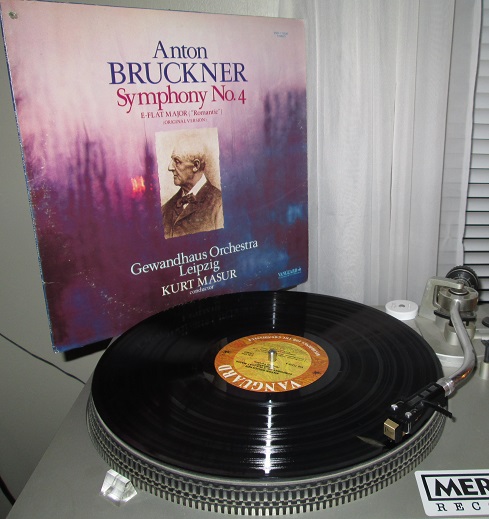
A couple of new-to-me Bruckner 4ths. The above version was really enjoyable - good sounding recording and performance. Unfortunately the record was a little scuffy in spots so I'll be looking to upgrade. The Bruno Walter version below was an interesting reading, but the sound was a bit on the shrill side. That can be the case with Columbia product, unfortunately. That's what tone controls are for. Dial back on that treble and you're almost there!
Some oboe music! Just hits the spot for me. What can I tell you? Being immersed in the music sure beats reality. Though I realize how fortunate I am to be able to do that. Honestly music has always been my escape hatch to counter the harshness of reality. Even when things are good - especially when things are not. I am thankful for the "roses" and the time to smell them. If I keep up what I do, maybe others might be able to have more of that too. I may not have had much time to write lately yet the message remains the same - check out some other vibrations if you can. And keep a light in the window. Until next time.......peace!