Wednesday, April 16, 2014

Crashing the party – Is Classical the new Rebel Music?

Ever been in a socially awkward situation? I can recall a couple of instances when I accidentally found myself amongst a class of people to whom I very clearly, and awkwardly, did not belong. It was palpable. Uncanny. Creepy.  To the extent that my very body language gave me away as “not one of them”. Holy moley – talk about funky vibes. I’ve felt ‘em. Thank goodness these experiences were not long, drawn out affairs. I had the option to flee and flee I did! Why do I mention this? Audiences. It’s all about audiences.

What listeners agree upon as “classical” music was initially designed, executed and consumed by and for an elite audience: Royalty and/or wealthy patrons of Europe. Everybody knows that. This elite patronage system eventually gave way to the wealthy and powerful bourgeoisie of the Industrial Age (and post-industrial age). Add to this list the powerful corporations of the present times and we can easily discover who this music was meant for. Charles Ives identified them as “blue haired old ladies”.
He was especially critical of the ultra-conservative tastes these rich, blue haired oldsters harbored (and how this often prevented contemporary composers from having their works performed). It should be noted, however, that Charles Ives did not attempt to earn a living from composing – he was an early insurance mogul. Perhaps his own wealth afforded him the opportunity to compose radical music since he was not chained to the market created by the tastes of conservative listeners. He could afford to compose weird music in his spare time and with his own wealth was able to hear it performed occasionally.


When placed into this context, it is somewhat astounding that “classical” music managed to gain a sizable audience in the 20th century from decidedly non-elite segments of society. I am thinking primarily of the United States here, although the same could be said of other countries perhaps even in the old communist bloc of the Cold War era. In the west there was enough of a market for this music for privately owned businesses to emerge and thrive in their efforts to meet the demand of the listeners. This market was made up of two rather distinct audiences for music, which sometimes overlapped yet remained distinct from each other: those who go to concerts and those who don’t. The non-concert-going people might be just as passionate about music, but participate as home-listeners either to radio or physical music products. The live music audience might often come from upper classes who can afford to spend an evening out as a leisure time activity, though concert audiences have been known to include folks from humbler origins too. The home-listening audience was fueled by changes in technology at the dawn of the 20th century.

Radio was to the people of the 1920s what the internet and mp3 technology has become for the current age. Radio created a new gateway for the masses to experience music at the dawn of the 20th century just as ipods have created more convenient access to personally selected music for today’s listeners. Having a large, portable selection of music readily available wherever you go has only increased the size of a listening audience. Radio was an alternative to having someone in your family with the ability to play a piano and a piano itself in the house. Radios were much cheaper and most families had one – even families that didn’t yet have running water in their homes or even electricity. Those families had the same option to hear music as families from more fortunate backgrounds.

Yet, the origins of having a personal collection of music to choose from came from essentially the same businesses that manufactured home radios – furniture companies. Radios were initially big pieces of furniture. As an alternative to the piece of furniture that played someone else’s music choices, the technology of flat shellac discs containing musical performances was pitched mainly to sell the piece of hardware to use those discs on. Many early record companies started life as subsidiary companies created solely to provide the “software” for the playing devices. RCA-Victor called its piece of furniture the “talking machine” – you’ve seen these before, right?
When you stop to think how much time has passed since these devices were last considered “current and viable technology” to now – the furniture companies must have made boatloads of these things for there to be so many still lingering in antique shops and the like. Again, probably cheaper than a piano.
An entry-level Victrola would set you back $15 in 1913. In today’s money that’s about $350. A step up cost $25 or nearly $600 in today’s money. Consider how much more sophisticated an object a piano is to a Victrola machine, the piano would be far more expensive indeed.
Notice too how the early advertisements for the Victrolas featured classical / opera stars as opposed to popular singers. Enrico Caruso was arguably the most famous of such figures. What the shellac discs contained were arias and shorter segments of notable operas. So, even if the music was not familiar, listeners would have a bite-size portion of a larger work at their disposal. Consumer-friendly indeed. As the industry became more sophisticated, books of several discs bound together were sold containing larger works spread out over the many sides of the records. Like this:
Listening to a whole symphony on sets of 78s took a level of dedication not even vinyl LP lovers would find tolerable. Yet, these things did sell in their time. Even the playback machines improved over time with the advance of electricity rendering the old acoustic machines obsolete. Once the post-war world emerged, both magnetic tape and micro-groove LP records would rapidly replace the shellac-dominated physical materials of recorded music pretty much permanently. Until the digital revolution, of course. From the mid-1940s at least until the mid-1990s, vinyl LP records made up the bulk of the physical material for music buffs to consume their sounds on. This, together with the general post-war prosperity (again, the focus here is on the US), would spread “classical” music to even further-flung corners of the country (geographically and socially). In fact, it could be argued that a general music-infrastructure existed in those years that is somewhat in limbo right now. How so?

Classical music has never before been so immediately available as it is today. On this blog I tend to focus on vinyl mostly. Yet, there is a ton of it for free right on the internet. Plenty of sites offer free and legal downloads sometimes of high-quality radio broadcasts from regional orchestras that are quite good. In fact, I am painfully aware that by limiting myself even to LPs and CDs I’m missing out on some great current performances. Yet, with so much available the question remains – Where is this music going? Does it have a future? If it does, who is the audience?

With the recent economic downturn of the last six years or so, too often I’ve seen in the news about once-thriving city orchestras packing up their music stands for good or close to it. The Cleveland Orchestra went on a high-profile strike four years ago and the Philadelphia Orchestra declared Chapter 11 more recently. Both orchestras have rebounded in the ensuing years, but concerns about the larger picture of appreciation linger on. Some orchestras are proposing radical changes to their mission statements – arguing that their roles in the communities they operate in ought to be more holistic than traditional. I think orchestras, like any other institutions, will only manage to be traditional as long as their wealthy sponsors allow them to be. Propping up tradition is a costly endeavor. Maybe things do tend to stay the same the more they change.

Often enough I wonder what potential audience there might be for music of the “classical” or “serious” variety as the future unfolds. Another tragedy of tough economic times is the continuing disintegration of the arts programs in the public schools across the country. Where orchestras have managed to survive from infusions of money from wealthy sponsors, the schools have been cutting back on music education more and more without any help or bailout. Where do these sponsors to the big orchestras think the musicians are going to come from? Vienna? Studies have been conducted to illustrate the terrible effects of cutting music education in the public schools on culture. With all the free music that is available, the irony is that fewer and fewer young people are being exposed to it and not just due to changes in education funding.

Part of what has driven me to seek out more classical music in recent years is the fact that the very sounds of those orchestral instruments are rapidly receding from even the most casual music sources. Hollywood films, TV shows, supermarkets, hotel lobbies all feature some kind of “rock music” in the background. Department stores now play generic sounding “rock music” – little of which is identifiable to me. Let me tell you why “rock music” emerged in the first place. It was not due to overexposure to Beethoven (sorry Chuck Berry). It was due to a general profusion of light orchestral music – MUZAK-type music. “How much is that doggie in the window?” kind of stuff. The easy-listening channels well into the 1980s played this junk. Rock and Roll was a rebellion against fluff. Today the easy listening stations play music that is essentially LIGHT ROCK. Beethoven performed by quality orchestral musicians sounds positively radical in today’s music climate.

The notion that “classical” equals “easy listening” is a massive misconception. Stravinsky, Varese, Mahler and Messiaen would all agree. I think there may be others in my age group and demographic who are likewise getting fed up with the general “rock music sound” of current filler-music in our society. Modern rock has become the new easy listening and it lacks soul. Not soul as in “soul music” but depth of feeling. The sounds I’m hearing from “classical” records in my collection are abundant in depth of tonal color and compositional excellence by comparison. Every platter is like a sonic vacation. Even from the most unlikely sources………
Check out those box sets above. I found these 4 2LP box sets of Arnold Schoenberg’s music a few weeks ago – Volumes 2, 3, 5 and 6. The series went up to Vol. 8 so I’m only missing 1, 4, 7 and 8. Of course that isn’t everything Arnold Schoenberg composed, but it’s a nice overview. I haven’t made it beyond Vol. 2 yet, but I was pleasantly surprised at how musical this stuff is. He has a rather fearsome reputation – considering he is the guy who invented 12-tone / serial composition. I expected his music to sound really ugly. Not the case. In fact I’m hearing a wonderful diversity of emotion so far. Once again, I’m not approaching  Schoenberg’s music from an academic point of view – I’m listening and reacting emotionally. I’m really looking forward to tracking down the missing boxes now!
Here’s a Ligeti record I found recently too. For another modern composer, this is really fun music! I have quite a pile of 20th Century records to dip my ears into. It isn’t easy to find this stuff in flea markets and thrift stores, but once in awhile it happens.
Like this famous Electronic Music record with Steve Reich’s “Come Out” on it. Captain Beefheart loved this record and played it a lot, which explains a lot! While I was listening to it the first time I really believed I might go a little crazy until I got into the flow of the piece. I found this at a local flea market at a booth with nothing but Wayne Newton and Barbara Streisand records otherwise. What this thing was doing there who knows?
I also found a bunch of nice imported LPs mostly of classical and romantic-era composers, but still excellent stuff like this Mozart LP. As much as I like intense and experimental music, I cannot deny Mozart. His music is enjoyable and intellectually stimulating. And, even though his music may appeal to the power elite, the 20th century has proven that it is music for everyone – just like Schoenberg’s. The proliferation of inexpensive, quality record playing devices in the 20th century helped to turn this music into a populist art form. For those seeking a deviation from the norm, there are some amazing vibrations out there in the record bins. There are other realities to consider beyond what the modern media outlets force upon us. There may be an alternate future available if we know where to look.

Keep seeking and listening!


Sunday, March 16, 2014

Moving, Organizing Classical Records and More Friggin’ Records!

Over the course of the past few entries here, I’ve made reference to the fact that I moved into a new place. I am conscious of how blessed I am to be able to make such a transition at this point in my life. In fact, I couldn’t imagine having to make such a move in the years ahead of me. Not that I’m particularly old by today’s standards, but what complicates my ability and desire to move is my not-so-convenient record collection.

Oh, sure. I could have been a stamp collector. Or a coin collector. Or even a comic book collector. But, no: records, compact discs, reel tapes, cassettes, 45s and yes even 8 track tapes. Since I was about 7 years old. And I haven’t been 7 in a looooong time. My collection was already obnoxious enough before I caught the classical bug – a disease I had long feared since I knew what could lie ahead. I recall making reference on the blog here to The Classical Annex. Tower Records, in the old days, often had a totally separate store just for classical music located nearby their already bulging popular, jazz and everything else store. Taking my cue from Tower, I decided to create my own Classical Annex – for my physical music collection and for my reflections here. I just couldn’t see filing my Beethoven LPs next to my Bee Gees records. Not that I make much of fuss about appreciating different styles of music. It has more to do with organizing.

Ugh. Organizing. Classical music makes for some challenges in this department. Before the move, I created some home-made shelves for the express purpose of organizing the classical records. I was pretty stoked since it was a wall-length cabinet that fit perfectly in my basement. Yes, I was a basement, man-cave dweller for a number of years. With the move I have been forced above ground and those home-made shelves are not, shall we say, aesthetically pleasing. Fair enough. So, until a few weeks ago, the bulk of my classical LPs were confined to The Garage. Not that it was a bad thing since the new garage is not that different from the old basement. But, there are lots of other things that need to be in the garage and I felt separated from my records.

So it was I found some very affordable new shelving units that allowed me to move the rest of my classical LPs up into the above-ground-man-zone. It was with great relief that I managed to fit and organize them all thusly.
Of course I have another side cabinet with more classical records – many box sets and a number of old mono jobs. In general, I managed to maintain a reasonable approach to organizing – roughly chronological and regional. Outside of those parameters I have separate sections for guitar music, piano music and opera. Not to mention “world music” releases.
The benefit of all this is a renewed interest in some records I haven’t played in awhile. For example, I’d missed hearing this great Mozart LP:
As well as my favorite Bach cello record:
I also wanted to hear a more recent Brahms’ 1st since I feel like I’ve finally connected with this symphony via the mystery Camden LP I posted in another entry.  I’d had this Szell / Cleveland version for a while so I gave it a spin to see how it measures up.
Enjoyable, yet there is still something missing from Szell’s performance that is evident in the mystery Camden version. I still haven't discovered who is actually performing on this disc:
Over the past year I'd noticed as my collection was growing I kept running into a lot of the same LPs in the thrift shops. As much as I like Beethoven's 5th Symphony, there are only so many of those that I'm going to drag home. Even with some of the more esoteric composers, there are certain popular pieces that get recorded over and over again. So, I began to notice where classical LPs might exist at all, chances are I already had the more popular titles. And finding the offbeat stuff isn't as easy, at least not cheaply.

However, I once again was reminded that it sometimes pays to return to places you may have previously written off. Some of my usual haunts have been starting to dry up as of late. I found myself this weekend going into a thrift that I had avoided for awhile because I'd only seen the most battered copies of Herb Alpert you'd ever see there. Maybe some well-loved Barbara Streisand. Hopeless, usually. Well, well! Here's what I walked out with:
About 50 classical platters, many of which were modern classical and mainly stuff I'd never heard before - MINT SHAPE. The woman behind the counter remarked how she'd just put those records out onto the shelves. Needless to say I was happy to get them out of her way. Here's a quick look into what I found:
Busoni Violin Sonatas 1 & 2. Pressed by Decca in the UK. There were several imported LPs included in the mix. Can't beat the sound on those discs. Managed to listen to this record already. Violin and piano. Great!
I think I may have uttered an explicative when I saw this Conlon Nancarrow album. This is the kind of stuff I usually only dream about. Not that it's an expensive record, per se. It's just too friggin' cool!
Ditto the Ligeti record. Believe it or not, even before I saw the big LIGETI name I noticed the record label symbol - Wergo. That's all I needed to see to put it in the "to go" pile. If it's on Wergo it's going to be interesting. By this point I wouldn't have been shocked to see some Stockhausen. Unfortunately I didn't this time.
Found another one of those Westminster Gold albums. Not exactly a striking cover this time, but John Williams is a favorite guitarist and I'd never heard of the composer Fernando Sor before. As it turns out - great stuff!
I was really happy to see this 3 disc box of Shostakovich's Complete String Quartets Volume 1. Especially since I'd scored the Volume 2 box a few months ago. Now I'm set for his string quartets! Awesome!
There were a number of vocal records too. I'm not so big on that stuff, but I had to grab a few examples. Here's a record of songs by Debussy. Songs by Debussy? Hmmmm. Yeah, I'll give that a whirl for a dollar. Nice 60s DG "tulip" label import.
Just as I was typing this entry up I had to play this record twice. Well, at least side two. Side one has an interesting Hindemith string quartet - #1 apparently. I like Hindemith well enough, but I'd never heard the composer on side two. WHOAH! Malipiero's piece, Rispetti E Strambotti for String Quartet, is really awesome! The only downside to this record is that I ended up with the fake stereo copy. Would have preferred the mono (I guess this was one of the earliest Nonesuch releases since the mono catalog number is H-1006. I have H-1001 somewhere and it is indeed a mono record.) Perhaps I'll find the mono somewhere down the line.

Well, there you have it. Just goes to show it always pays to look in places you'd least expect to find cool platters in. Maybe since those records blew out of the store so quickly maybe they'll try to put more out in the future. I'll be sure to post the better records from this haul in entries down the line.  Happy hunting and listening!

Tuesday, February 11, 2014

The Universal Language?

       There are times when I can’t decide if music is – or isn’t - a “universal language”. On the one hand, there is ample evidence showing the importance of music across the different cultures both geographically and chronologically (from ancient times to the present). Not all cultures placed equal value on music, but I’d reckon even the Vikings had some sea-shanties to sing on their frequent journeys between Europe and North America. On the other hand, what some cultures might call “music” could end up being experienced as “not music at all” by other cultures – or “pretty confusing sounds attempting to be music”. Check out this great clip of Bulgarian wedding music from the classic TV show “Night Music”:

      This is one of my favorite performances ever – from any genre. I remember when it first aired back in the late 1980s. Exciting stuff then and now. Yet, this music does not have the same tonality as western music. There’s semi-tones all over the place! Pretty challenging vibrations for most westerners to navigate. The musicians also seem to know the significance of the different sections of the music in a way that is lost on anybody who didn’t grow up going to weddings in Bulgaria. Yet, I still love this music, as ignorant as I am about the intricate subtleties. I wouldn’t be surprised if most folks in this hemisphere found Bulgarian wedding music baffling to listen to though.

      In some ways, even after a few good years of solid listening, I feel like I am as ignorant about “serious” (classical?) music as I am about Bulgarian wedding music. I reckon this is the difference between listening and studying. I get to do more of the former, not so much of the latter. Sometimes I wonder how long it could take to reach a higher level of appreciation for “classical music” at the rate that I am going. As much as my life schedule allows I do my best to hunt down some criticism / insight about the pieces of music I am listening to either on the internet, in album liner notes and/or the odd book or magazine. My inability to play a melodic instrument (such as piano) also limits my understanding to a degree (though, to be fair, there are plenty of examples of composers who did not excel on a musical instrument themselves).
      Often times, composers will include musical quotes either from other composers’ works or from the folk music tradition from their country (or sometimes from a totally different country). If one isn’t exposed to those other sources in their original forms, the possibility of appreciating the music at its most sophisticated level is quite compromised.  A few years ago I listened to Charles Ives’ Symphony #2 and I was immediately struck by how many musical quotes he wove into the work – quotes that I recognized from the American folk music tradition. In fact, I was really startled to discover how many of those musical quotes I recognized and that got me wondering about what I might be missing in other composers’ works.

      In order to bridge that gap I would have to spend more time delving deeper into the folk traditions of lots of countries and cultures! Bela Bartok infused his music with the folk songs of his region.  Dvorak, same thing. Sibeluis, Stravinsky, etc…..down the line. Which begs the question, “Who are these composers writing for?” If they are including music from their own country, are they nationalist composers creating works of art for their fellow countrymen?   Or can their music be appreciated by those who might not get the “secret references”? This is the crux of the matter for me.

      No matter how influenced by national or folk-based music a composer might be, I would have to believe that he / she would want the largest potential audience for their music while avoiding some sort of “sell out”. Plus I also believe that Beethoven threw down the proverbial gauntlet in terms of riding the balance between art and accessibility. Every other composer following in his wake will be caught up in his shadow whether they like it or not. Even if it comes to being the “anti-Beethoven”, he is still the “something” to be “anti” to!

      Is any of this really important? Maybe not when it comes to enjoying great music. Yet, there are deeper levels to uncover – more profound levels of appreciation. I may be impatient, but I am looking forward to finding out how far I can go on this journey. Here are a few new acquisitions that inspired some of the burbling blather this month……
     Here is an interesting copy of a Beethoven 9th performed by the Czech Philharmonic. The recording originated from a broadcast done as part of a benefit concert for a children's charity organization. I scored a bunch of Supraphon records from what was then Czechoslovakia a few weeks ago. I couldn't help notice Vaclav Havel on the front cover with the conductor and one of the featured singers (not sure which). The copyright date is 1990. Those were exciting times indeed with the fall of the communist bloc. The performance of Beethoven's 9th is enjoyable enough, if not definitive. Note how Beethoven, once again, is being performed for an event with "universal" appeal. For more nationalistic sentiments, a performance of this piece might be more appropriate:
      BedÅ™ich Smetana's classic Má Vlast, again by the Czech Philharmonic, is a totally enjoyable piece of music. Some folks like to focus on the part known as The Moldau - one of the more popular segments of this larger work. I really like the whole shebang. Need to check out other compositions by this great composer.
      Here's another LP from the Czech haul. I really like cello music so this was an automatic purchase for me. Plus the composers are lesser-known, 20th Century composers from the region. Who knows how often this music has been heard outside the Czech region? Just give me cello or two and I'm a happy camper.
     Vaclav must be a very popular name in this part of the world. Here is Vaclav Hudecek working out on a couple of Dvorak violin concertos. I was happy to hear really excellent intonation from this performer. I tend to be pretty picky when it comes to violin music so I lucked out here. Then again, I also have yet to hear a composition by Dvorak that I don't like.
      Here's another one of those pink RCA Camden mono LPs probably sourced from 78s of a Brahms 1st Symphony. This was a piece I really hadn't warmed to yet until I heard this performance. I really wish I knew the real identity of the conductor and orchestra featured here. Leave it to a cheapo album to get me into a piece of music for the first time. I always felt Brahms was trying too hard to please with this symphony, yet somehow this anonymous conductor managed to wring the music out of the score here. I love these cheapo Camden albums.............
     This album was a reissue of 78s that were recorded around 1905. This is even before the advent of  "electrical recording" when sounds were amplified electrically for better fidelity. These recordings were "acoustic" - whatever noise you could make through a bullhorn was directly cut into acetate grooves. The singer - Lilli Lehmann - was about 60 years old when these recordings were made. She was born in the 1840s, dude! What did singers who were born before the Civil War sound like? For $1 I was gonna find out! Not bad, really............
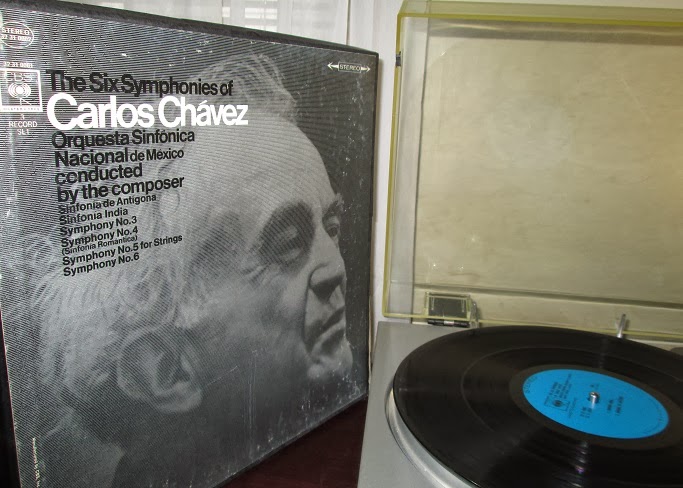
     I had never heard of the Mexican composer Carlos Chavez before I found this unplayed box set of all six of his symphonies. Great 20th Century music that leans more toward the interesting side as opposed to the obnoxious side. Very enjoyable and eclectic pieces here. Lots of percussion here as well as some ethnic, folk instruments added to the mix. This is the kind of stuff that keeps me going - I love discovering new composers. Chavez's music is highly recommended.
     I also recently found this box set of the first three symphonies by Danish composer Carl Nielsen. I have some of his other symphonies on single LP releases, but I didn't have these. So far I've listened to the first symphony a bunch of times and I'm finding it hard to remember. The music is well constructed, but not terribly memorable. I am hoping to hear more adventurous vibrations on the other two symphonies here. Nice to have the first three in one place anyway............
     Last up for this month is a Copland piece I had never heard before - the Clarinet Concerto written for and featuring jazz legend Benny Goodman. This is an excellent and totally enjoyable piece - moody and mysterious. Goodman's part doesn't involve a lot of pyrotechnics, but is a thoughtfully constructed voice that takes a lot of skill to perform well. The other side of the record compiles some American songs - some of which date back to before the Civil War. I have to say I always find it odd when trained classical singers perform what are essentially folk songs. Too often, the bombast of the operatic voice undercuts the charm of the original melodies with the results sounding like some sort of academic exercise that ends up sounding too forced to be taken seriously. Not my cup of tea, but then at least half the album is worth it.

     So there you go - lots of listening in different directions. I'm not sure how focused I may ever be when it comes to my listening adventures, but for now I'm okay with that since I'm having too much fun just hearing new and exciting sounds. Keep 'em rolling and keep 'em spinning! Until next time........


Sunday, December 29, 2013

Oh no, not Mahler again!

I can’t quite figure this out. For the past few years I’ve had spontaneous Mahler-itis  in the month of December. I wouldn’t have noticed a pattern if I hadn’t been keeping track of my listening sessions (as I’ve been doing over the past several years). Only a few weeks ago I grabbed my Mahler box and listened to three symphonies in one day – the 5th, 6th and 7th.
 Prior to that I finally got around to listening to my Mahler 9th Symphony disc with Pierre Boulez conducting. That was the last of the big Mahler pieces I needed to hear. It really seemed to me to be a final summation of everything else that came before it. All the thirty-one flavors were available under one roof with the 9th. (Possibly only here will you get a comparison between Mahler and Baskin-Robbins Ice Cream).
I therefore feel it is my duty to point out that if you’re expecting a scholarly dissertation about Gustav Mahler and his celebrated musical output on this blog you’re probably going to be disappointed. No worries, though. If scholarship and analysis is what you crave, there is no shortage of this information elsewhere on the web. Mahler is one of the most widely written about composers of the late Romantic era. Mahler is to the “serious” music world what Bob Dylan is to the rock and roll world. Mahler’s work has been dissected, theorized about, re-imagined, extolled and debated-over ad infinitum. In a previous entry I made the case for the emergence of the long playing 33 1/3 RPM album in the late 1940s and the ascendance of Mahler’s star in the latter half of the 20th Century. That is, in my opinion, one half of the puzzle. The other half of what may possibly explain the fascination with Mahler into our current times, comes from a theory proposed by Leonard Bernstein.

Bernstein made it part of his life’s work to actively crusade for a greater, more sweeping recognition of Mahler’s work beyond the symphony halls of the world. Bernstein believed Mahler’s music was the secret key that would unlock a deeper understanding about modern humanity’s place in the post-World War II era (continuing through today). If I’m reading Bernstein correctly, this understanding would transcend even the limited timeframe of the Cold War (Shostakovich being more suited to musically documenting that era). Leonard Bernstein certainly must have believed in Mahler’s music, maybe even more passionately than his own, since his recordings of the Mahler symphonies are considered among the most definitive by experts. Those experts – the Mahlerites – have been a lucky bunch over the years. Between the proliferation of the music on records and Bernstein’s tireless promotion of it, appreciation of Mahler is arguably at an all time high. The Mahler vibe is alive and well with no signs of diminuendo.

When I started out on my slightly more organized journey into “serious music” one of the first pieces of music I sat down to listen to was Mahler’s “Song of the Earth”. I got a mint stereo copy of this famous box set with Fritz Reiner conducting the Chicago Symphony Orchestra as part of a freecycle haul years ago. I kept this especially since I remembered reading an article on how The Beatles’ song “Not a Second Time” had a harmonic similarity to the ending of Mahler’s work. Here is that famous article:

http://www.beatlesbible.com/1963/12/27/the-times-what-songs-the-beatles-sang-by-william-mann/

Not that The Beatles had any conscious idea of what they were doing (most likely)! True or not, this association stuck in my mind years later so when I came across this 2 LP set in the pile I knew enough not to discard it. I’m not sure what the heavy Mahlerites think of the Fritz Reiner / Chicago Symphony / RCA “Living Stereo” version of Das Lied. I do know what I thought of it on first listen……confused as hell! Of course, it isn’t always advisable to read the last chapter in a book to get a sense of what the story is about. What I did manage to learn about this piece is that it was inspired by some ancient Chinese poetry which may or may not have been translated into Mahler’s German very well. So, I figured if Mahler was stuck with an inaccurate text to work with, how critical can anybody be when it comes to this kind of music?
As it happens, my listening to “Das Lied” coincided with the passing of a friend of mine, who happened to have excellent taste in music. Although we were not close friends per se, our conversations were always animated by a mutual love of great music. I had gone to visit him in the hospital when he took ill which ended up being the last time I saw him. I think he knew “this might be it” and as I was shaking his hand he held onto mine for a slightly longer period of time than what would be considered normal. It was a final goodbye.

    Returning home from my friend’s wake later in the month, I immediately felt it was the right time to hear “Das Lied”. True to my own processing pattern, I felt more moved by the overall sound of the music than of the significance of the texts. What can I tell you – I’m just not a lyric guy! When I started hearing other Mahler works I eventually realized that “Das Lied” stands a bit apart from his other works since it has a generally even-keeled sensibility to it – stately and somewhat morose, yet dignified. However, the music is not sentimental Romantic mush. The music borders on the “modern”, in fact. Which is precisely where Mahler belongs – feet in the Romantic era, head in the modern.

“Das Lied” was apparently sketched out initially as an almost-9th symphony. Some Mahler experts see it this way, while others will point out he did finish a proper 9th and started a proper 10th. I think Mahler was fairly obsessed with the symphony as the ultimate framework of expression for a composer’s true inner self. Which is fascinating when one considers he spent most of his working life conducting opera. What’s even more amazing is that he managed to compose as much as he did with such a busy conducting schedule. Still, the modern technology we have now affords us listeners with the opportunity to own a single box set with quality performances of every stitch of music he feverishly scribbled onto staff paper (like the one pictured above).

    I didn’t just jump from “Das Lied” to the box set, however. Like I said, “Das Lied” hit me on an emotional level, but otherwise I was pretty baffled. I figured maybe this Mahler guy was ultimately too doom-n-gloom for me in general. It took going back to the beginning to gain entrance to the Mahler inner sanctum. My guide would be Bruno Walter – early champion and friend to the composer for many years. The piece would be Symphony #1.
Ironically, the third movement of this piece had something in common with a Beatles song. In 1966, the Beatles released a hard-driving single with a great vocal by Paul McCartney called “Paperback Writer”. As part of the backing vocal part to that song, the French children’s folksong “Frère Jacques” provided the main inspiration. Once its pointed out it becomes very obvious, if it isn’t noticed anyway. In Mahler’s 1st, “Frère Jacques” also forms the main backing motif for a “funeral dirge” movement. Just as the Beatles would do many years later, Mahler uses this common folksong to his advantage – the melody moves the piece along, yet it serves to provide just the perfect touchstone melody to hook the listener in with a familiar tune. At least, that’s what it did for me.

    Mahler’s first can fit on one LP and, although it didn’t wow the concert-going crowd at the time of its premier, it is one of the most commonly found pieces of his on record. I’ve seen mad, crazy copies of Mahler’s 1st  - I have lots on LP and there’s plenty I’ve left in the bins for others to plunder over the years. As it happens, conductor Michael Tilson Thomas dedicated a nice episode of his “Keeping Score” series to Mahler’s 1st which blew my mind even further! There’s all kinds of intense stuff built into this symphony – things I never would have known about if it weren’t for this cool series. I was going to post a link here - especially since PBS has kept the video on their site - yet its no longer featured! Let's hope they bring it back since it was really awesome. Well worth seeking out somehow........

From the 1st, I wound up jumping to the 5th. Unfortunately, I bought a Karajan mid-70s recording that baffled me even more than “Das Lied”. It was rough going trying to grapple with that thing! Eventually I grasped onto the last movement which seemed to tie everything else together, but Karajan’s reading is far from my favorite these days. I’d give a nod to Bernstein’s reading from the 1960s on Columbia.
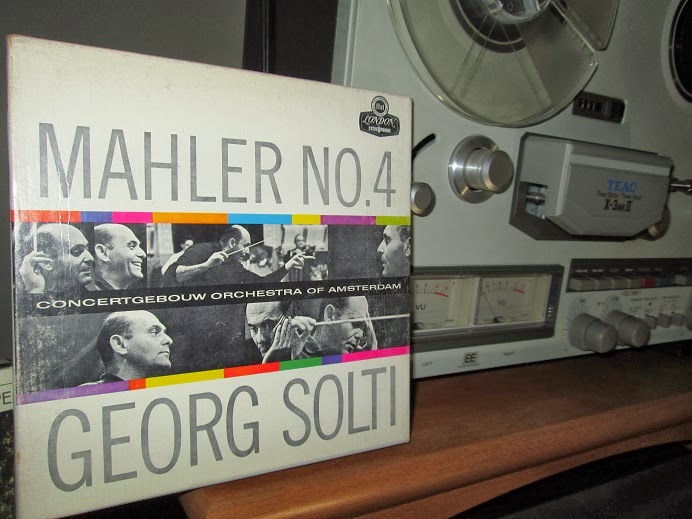
After the shock of the 5th, I was pleasantly surprised by the user-friendliness of the 4th – another short-n-sweet symphony in Mahler’s cannon. I’d initially heard a cheapo version on CD, though now I’d give the nod to Fritz Reiner’s version. I then jumped over to the 8th – The Symphony of a Thousand. I really liked the Solti reading for Decca in the early 70s.  At this point I’d been leapfrogging around the symphonies and felt I needed to take a more chronological approach. I also decided that simply pulling the pieces off the CD box set would be too passive for my listening habits so I set about finding some remaining symphonies on vinyl. I got ahold of a 2nd and 3rd this way – both being double albums! The 2nd was a reissue copy of  Bruno Walter conducting the New York Philharmonic. The 3rd is a Bernstein / New York Philharmonic reading from the early 60s.  Both of these albums helped me to dig in deeper and discover the uniqueness of those two excellent pieces.
At around the same time I found LP copies of Bernstein’s 60s performance of the 5th (better than Karajan’s) and Szell’s reading of the 6th with the Cleveland Philharmonic. All of these pieces are LONG. Mahler loved long symphonic works. Having the music broken up over the course of 4 LP sides provided appropriate breaks for me. Getting familiar with all the different movements of each symphony somehow was easier with the vinyl LP format. It was only after playing the records a bunch of times that I felt ready to move back to the discs in my CD box set.

    The one exception to this approach was my first listen to Mahler’s 7th which involved an open reel tape of Bernstein and the New York Philharmonic I got off ebay cheaply. It turned out to be excellent and I took to it right off the bat. Here are a few other Mahler open reels I have:

Take a look at this wacky thing:
A misguided attempt to make Mahler psychedelic for the hippie crowd? This record has excerpts from various symphonies – presumably the more popular parts. The sleeve notes on the back of the jacket were written by Dave Marsh from Creem Magazine. I don’t doubt his sincerity about appreciating Mahler’s music, but to compare Mahler to Jimi Hendrix, Janis Joplin and the MC5 is just a bit too much! Decca Records created an imprint for this series of classical samplers called “Orphic Egg”. Take a look at this inane legend on the record jacket:
I think Mahler would have been appalled. This “Orphic Egg” series must have been concocted to compete with the Westminster Gold weirdness……..

    Instead of “Mahler’s Head” I decided to re-listen to “Das Lied” while I was typing this. My ears tend to accept the rougher edges of the tonalities here and overall I am enjoying the music. Yet, I’m feeling conscious of the fact that I am not reading along with the words. Ah, with any luck I’ll live to a ripe old age and have nothing better to do than to revisit ALL of the Mahler symphonies several times over during the course of a prolonged retirement on my way out of the temporal world.

Music can play a big part of that passage through the temporal zone, as it did for Herr Mahler. His symphonies were like planets unto themselves – he designed them as such. Yet, just as time passes – what were burning questions and desires at one point are superceded by other questions and desires. It was Mahler’s job as the composer to document his inner life for all to hear. That his music had a particular resonance long after his death is quite astounding. We don’t tend to think of composers as visionaries and mediums. Yet, it is often the case that those who dare to dream big dreams tend to dream outside the confines of the grey, blah and “meh” existence us mere mortals inhabit from day to day. Our lives become that much richer when we dare to dream along with our sonic spirit-guides.

    Keep those dreams grand and bold in the new year! Thanks again for stopping by to read this stuff. As always – Happy Listening!


Tuesday, November 12, 2013

Delius & Kate Bush


 Years ago in the mid-80s, before I discovered college radio, I remember hearing  Kate Bush’s  “Running Up That Hill” on the local “rock” station (this was before they gave up playing new music). This song certainly didn’t get a lot of airplay, but my ears always perked up whenever it came on. Eventually the infrequent exposure resulted in my bringing home her “greatest hits” release “The Whole Story” – on vinyl no less.  “The Whole Story” was anything but though – she has managed to keep releasing new music right to the present day. More likely this collection was issued to satisfy her ready-to-expire contract with EMI America (her next new release would appear in 1989 on Columbia). While waiting for something new, I started picking up her earlier records from which the greatest hits disc was culled. I still don’t have all of them (missing Lionheart and that live thing whatever it was). Her first album was quite conventional with experimentation really starting to gear up by the third LP.

    On that third LP, “Never for Ever”, the second track was a curiously titled song called “Delius”. As is typical for me, I never gave much thought to what the song was about, lyrically. The music was so interesting I didn’t worry about the subject matter, except that it struck me as pretty obscure whatever it was. I’d learned not to worry too much about whatever Kate Bush’s lyrics were about since so many of her songs seemed fairly esoteric and well, who cares anyway? I still have that kind of reaction to music in general. Unless they’re memorable, interesting or insightful (or obnoxious) I really don’t pay much attention to words of songs. Or maybe not as much as most folks. As it is, the lyrics themselves have a minimalist aesthetic:

DELIUS:

Delius, he's a moody old man
Delius, song of summer in his hand
Delius, he's a moody old man
Delius, in, in, in his hand
Delius, in his hand

Delius
Ta, ta-ta
Hmm
Ta, ta-ta

Delius
Delius amat
Syphilus, Deus
Genius

Delius, to be sung of a summer
Delius, night on the water
Delius, on the water
Delius

Ta, ta-ta
In B, Fenby

Delius
Delius amat
Syphilus, Deus
Genius

To be sung of a summer
Night on the water
On the water
On the water


Hmm….what the blinking hell is that all about? Well, it certainly makes for more interesting mouth noises than “Sussudio” perhaps, but still. Remember, this was all way before the internet so you’d really have to dig deep to glean any kind of information and even then you’d wonder if the story you heard was accurate. This was still the era of the great rock and roll myth machine. In any case, Kate Bush had other bizarre song lyrics so this was not out of the ordinary. I hadn’t heard “Delius” in a long time until I recently played the whole record again……….in case you’ve never heard this particular track:
It’s funny how our brains react to old stimuli. I’d heard this song many times in my younger days and my brain settled into that same place the last time I listened – which was that sort-of semi-catatonic / confused wonderment, yet happy, state of just general enjoyment. Very nice and thank you………….until I couldn’t get “Delius” out of my head the next day and….oh! Wait a minute! I’ve been listening to “serious” music lately haven’t I? Oh, yeah – there’s a composer named Delius! An ENGLISH composer! Hmmm……now armed with google I went looking. Sure enough! In 1968, film-maker Ken Russell (responsible for, among other things, the much maligned Who film version of “Tommy”) made a black and white BBC Omnibus film about Frederick Delius. The basis of the film was a book written by a man named Eric Fenby who served as an apprentice of sorts to Delius when the master was in his advanced stages of old age and (crippling) syphilus. Whoooah! Surely Kate Bush must have seen this film (and, of course, here it is…..)
And, wonder of wonders, here is a clip from a British tv show where they brought Kate Bush and Fenby together making for esoteric, yet fascinating, cross-cultural / generational connectivity. Woooow!

 None of this would have ever mattered a whit to American audiences who basically still don’t know Kate Bush from Frederick Delius then or now. Kate Bush essentially held to her artistic and moral values by refusing to “sell out” or elevate her image above her music. Delius, for a variety of reasons, never quite managed to fit in with composers of his era – Sibelius, Mahler, Shostakovich, Ravel, Debussy – all of these are well known today. Delius was groundbreaking – one of the first serious composers to integrate the harmonies of African-American blues (field-hollers) and folk forms into his pieces long before Gershwin. This influence in particular comes from time the composer spent in Florida, sort of overseeing a family orange grove plantation (mostly he was preoccupied with music and, well, sowing his oats as it were).

From this formative experience sprung his now famous “Florida Suite”. This piece was decisive since it served as the ice-breaker between young Delius and his mentor Edvard Grieg. The elder Norwegian composer took Delius under his wing, resulting in Delius devoting his attention to composing full-time. Prior to this he was under the weight of his overbearing father’s wrath. It is no surprise that the young Delius, though British by birth, escapes Britain any chance he gets. Florida was first, France – Paris in particular – would be second. When one considers the variety of influences Delius brings to the table – born into a German family in England, spending time in America, befriending Norwegian composer Grieg and ultimately settling in France at the peak of the influence of the impressionist age – it’s no wonder that the resulting music from Delius’s mind explodes with originality.

For a very in-depth view into the life, work and legacy of this fascinating man, here is a link to a documentary done by the BBC in recent years.

http://youtu.be/uTVhBhPzPQA

Although it is extremely well done and informative, I hesitate to post the actual film here, mainly due to a bit of extra skin in one part that renders it perhaps family unfriendly. For those of less puritanical tastes, it really is quite innocent (although those depicted were decidedly NOT). Of course, the cautionary tale is that Delius’s fascination with the carnal endeavors would prove his own undoing – culminating in his contracting syphilus at 33 in an age where no cure existed. His final days of blindness and paralysis were evidently portrayed well in the Fenby-inspired film above.

What both films also display is the reality, in many cases, that composers can be cantankerous, narcissistic creepos of the highest order. And those who dedicate themselves to bringing that art into being – as Fenby did – do so at the risk of their own sanity. Fenby was not the first, nor last, to tread such a perilous path in the name of art. Total madness, if you ask me. But such can be the price of great music. I doubt it has to be that way. Genius can be a real pain the butt – an excuse for outlandish behavior that ultimately fails to convince (at least for me).

My own exposure to the music of Delius has been limited to four albums I managed to rescue from thrift stores. In some ways the music reminds me of a cross between Debussy and Charles Ives – particularly with the influence of American motifs, as can be heard clearly in the Appalachia piece. Note how all but one of these albums feature the conducting of Sir Thomas Beecham – for many years the sole champion of Delius’s music. Later on Sir John Barbirolli would also help to get Delius’s compositions before the public. If there is any one common aesthetic to every piece I’ve heard (which admittedly is not that many) it sounds to me like freedom or a yearning for freedom.


What I like so much about lesser known composers like Delius is how they can provide for fresh listening experiences, away from the main repertoire. I have to admit, although I am not fully conversant with what has come to be known as that main “rep” – a process I’m still working on (and quite happily) – I do consciously seek out material from the fringes and / or the more “modern” aesthetic. Along with the Delius albums I’ve managed to drag home music by composers such as Nielsen, Rubbra and others whose music I have only just begun to hear. Sometimes even offbeat records can yield surprising favorites.

For example, I’ve been fascinated by those bizarre Westminster Gold releases from the early 70s with the wacky covers. I recently picked up this generic looking thing featuring music from a variety of lesser-known composers – names like Lavry, Voss and Bax. The latter I’d heard of before, but not the others. Well, this funky looking record is pretty awesome! A pleasant surprise, especially when I wasn’t expecting much. Not all “modern” music has to be abrasive and this record is a good example.

For some slightly abrasive modern sounds I decided to pick up this album by Elliot Carter.

The music isn’t overly obnoxious, but it does require a bit of getting one’s ear attuned to the proceedings. Elliot Carter recently left the planet at a rather advanced age. This LP is my first step towards rectifying my total ignorance about his musical output. So far so good!

When one considers how much off-beat music did manage to get released in the “LP-era” it must be remembered that the recording industry as a whole was able to sustain a fair amount of un-commercial music product due to the massive units of Elton John and Fleetwood Mac albums that were sold. The business was large enough to warrant some experimental releases without chipping away too much at the profit margin. As long as the major companies could count on the big sellers, taking a risk at a handful of esoteric releases was not such a big deal. This logic worked even for Kate Bush who never promoted her music in quite the way I’m sure her American record label would have liked her to. The originality of her work was enough to carry her career across decades. In some ways, she and Delius were very much alike in their respective uncompromising stance to their art.

What draws me to this kind of music is also the understanding that music of this nature is quickly receding – not only from the marketplace, but from the very fabric of modern culture. Strings, brass, woodwinds, percussion, choruses creating lengthy tone-poems and symphonic expressions have never been at such odds with the majority of musical sounds in the general modern environs. Radio, tv, movies – all of the major sound outlets now depend on digital, electronic / computer based sounds and compositions. Hearing large string sections with orchestral instruments for long stretches is such a radical departure from the everyday sonic norm of the current times – it’s downright radical. To me, a worthy antidote to an already overly-mechanized, technology-dependent, so-called “modern” society. There are other vibrations to consider on the journey, indeed! Keep seeking and listening!